

Protect the Forests of the Siskiyou Crest and Seiad Creek! Comment on the Seiad Restoration Thin Project!
The Klamath National Forest has released a Scoping Notice for the Seiad Restoration Thin Project, located on Johnny O’Neil Ridge, on the slopes above Seiad Valley in the Mid-Klamath River watershed.
Seiad Valley is a small hamlet in a beautiful and narrow valley, and a community set among the steep, unforgiving habitats of the Siskiyou Crest. To the west, Seiad Creek drains the eastern margin of the Kangaroo Inventoried Roadless Area from the rusty serpentine slopes of Red Butte to Cook and Green Butte, and over to Cook and Green Pass. Here, rock, chaparral, and sparse Jeffrey pine woodlands are the dominant features, with old-growth mixed conifer forest hiding deep in the drainages.
The area is known for its remote, highly diverse habitats, and relatively frequent backcountry wildfires. The Kangaroo Inventoried Roadless Area extends like a wall of rock and fire-swept chaparral rising from Highway 96 and the banks of the Klamath River, and from the bottomlands in Seiad Valley to the Red Buttes Wilderness and the spine of the Siskiyou Crest and its southern spur, aptly known as Devil’s Ridge.
Click on the play button to watch a short video of the Seaid Restoration Thin logging project area.
Yet, on the eastern flank of Seiad Valley, Johnny O’Neil Ridge rises green and forested out of Seiad Valley supporting deep fir forests, piney mixed conifer forests, small patches of oak woodland, ultramafic outcrops, and unique perched wetlands, springs and ponds.
Here in some of the last relatively intact blocks of closed canopy, unburned, mature and old-growth forest above Seiad Valley, the Forest Service has proposed the so-called Seiad Restoration Thin Project, a large forest management project and timber sale proposed under President Trump’s Executive Order 14225, for the Immediate Expansion of American Timber Production.
Although historically logged and roaded, significant mature and old-growth forest remains across the face of the ridgeline, and much of this forest is proposed for logging in the Seiad Restoration Thin.
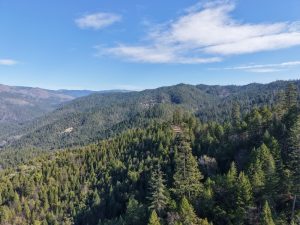
These forests are important for their connectivity value, lying at the axis of a regionally important connectivity corridor between the Marble Mountains and the Siskiyou Crest, the region is highly important for the connectivity it provides across the Klamath-Siskiyou Mountains. It is also extremely important for wildlife, including species like the endemic Siskiyou Mountains salamander which breaths through its skin and requires cool, moist talus habitat covered in closed forest canopy.
These forests also provide thermal cover for deer and growing elk populations, habitat for bear, cougar, bobcat, and other species that both live in and disperse through these relatively intact forest habitats.
Portions of the project area are also designated as Late Successional Reserve (LSR) forest to both protect and enhance old forest habitat for the northern spotted owl, the Pacific fisher, and other species requiring late successional habitat.
Unfortunately, the Seiad Restoration Thin Project proposes heavy industrial logging that would allow for the removal of large diameter trees, and for a dramatic reduction in canopy cover. The result would be to significantly alter forest microclimates, introduce hotter, drier, more windy stand conditions, and increase fire risks through the development of dense, young, even-aged vegetation wherever canopy cover is dramatically reduced.
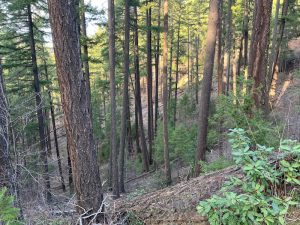
We all know that in the Klamath-Siskiyou Mountains, forest openings created by either natural disturbances or unnatural disturbances, like logging, tend to quickly fill in with woody vegetation, fine fuels and dense regrowth. This has been shown to increase fire risks, increase a fire’s rate of spread, create larger flame lengths and make fires more difficult to control.
To create these impacts in one of the region’s most fire-prone areas around Seiad Valley is irresponsible and will threatened nearby homesteads and communities with well-ventilated forests, susceptible to increasingly severe and fast-moving wildfires.
The logging of large trees, the canopy reduction, and the significant new road construction proposed in the Seiad Restoration Thin will negatively impact habitat values, connectivity and scenic qualities in the surrounding landscapes. The Forest Plan for the Klamath National Forest encourages the development and maintenance of mature, closed forest in the Visual Retention, Partial Retention, Riparian Reserve, and LSR land use designations that dominate the planning area.
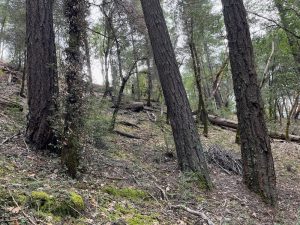
However, the Forest Service is instead proposing to log almost 2,000 acres using Variable Density Thinning prescriptions that would log large trees, dramatically reduce canopy cover, reduce habitat values and remove important old forest habitat elements, while making stands less resilient to future climate conditions, wildfire impacts, drought stress, and beetle outbreaks.
Klamath Forest Alliance is opposing the Forest Service’s heavy handed Variable Density Thinning Prescriptions. We are also opposing the significant new road construction proposed in the old forests above Seiad Valley. This new road, approximately one mile in length, would provide access for logging equipment in stands of mature, late successional and old-growth forest.
These old forests are among the most fire resistant habitats in the mountains above Seiad Valley, and buffer the community with relatively intact, healthy, mature forests that tend to moderate fire affects. These forests should be maintained by converting significant portions of the commercial logging project proposed by the Forest Service into non-commercial fuel reduction and prescribed fire units.
Responsible management in the Seiad Restoration Thin area and on the western face of Johnny O’Neil Ridge must ensure that any logging treatments proposed retain large, fire resistant trees and enough canopy cover to naturally moderate fire risks and suppress understory growth.
An active management approach to fire risk reduction in Seiad Valley should focus first and foremost on helping local landowners harden homes, conducting defensible space treatments within 100’ of homes and infrastructure, maintaining safe ingress/egress for evacuation planning, and treating Forest Service lands directly adjacent to private property boundaries to allow safe suppression options during wildfire events. This emphasis on protecting homes and communities would focus directly on community wildfire preparedness, not logging in backcountry habitats.
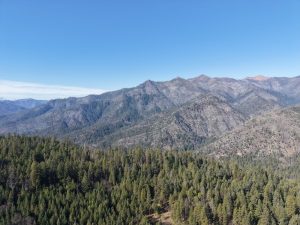
Please comment now! The public comment period ends on the evening of February 25, 2026. Please speak up for the forests of the Siskiyou Crest and Seiad Valley!
Talking Points for Public Comment
- No new road construction. The approximately one mile of new road proposed for construction above Seiad Valley should be canceled.
- Withdraw Variable Density Thinning treatments proposed in the Scoping Notice and implement activities that will maintain large trees and more canopy cover.
- Retain all large conifer trees over 24″ diameter and all hardwoods over 8″ diameter. Maintain canopy cover at 60% on north- and east-facing slopes and in mature Douglas-fir dominated forests. Retain 50% canopy cover on south- and west-facing slopes and in mature pine dominated stands.
- Thin from below. Do not log large overstory trees, degrade canopy conditions, or break up natural tree groupings.
- Maintain fire resilience by maintaining canopy cover, large fire resistant trees, and hardwoods. The retention of canopy cover will maintain microclimate conditions, reduce wind speeds, and reduce the development of dense understory growth or stand regeneration.
- Focus thinning operations on plantations and young stands where habitat conditions and fire conditions have been most compromised.
- Implement prescribed fire to maintain stand conditions. Consider maintenance burns between 3 and 15 years after manual thinning treatments.
- Implement no logging, yarding, road construction or equipment use in Riparian Reserves.
Comment by sending your comments to the following email address:
sm.fs.ca.klamathnf.projects@usda.gov
Please include “Seiad Restoration Thin” in the subject line